 Digital Center Circle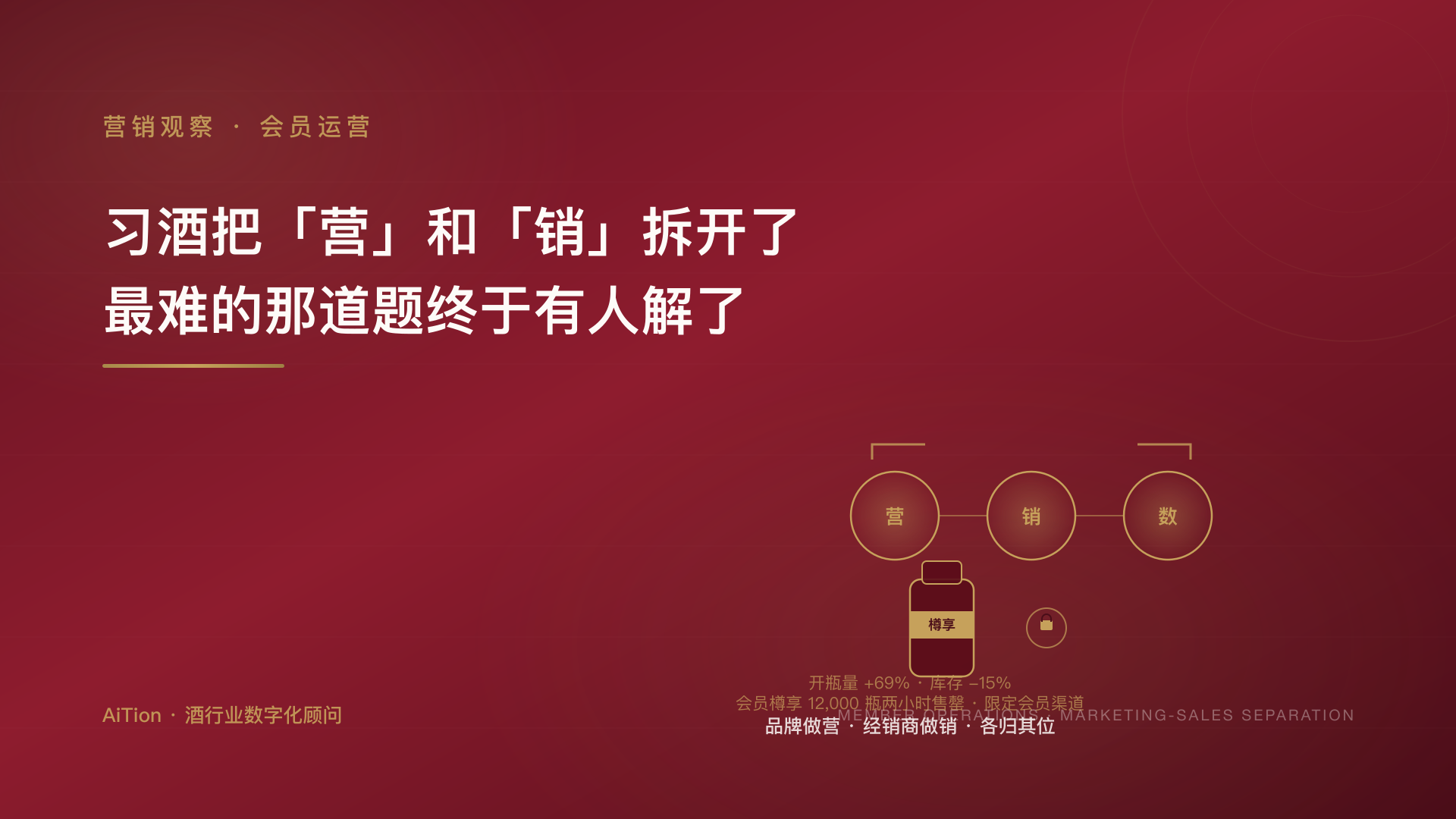
I. An Open Secret in the Baijiu Industry
Consumer operations are not the hard part—the hard part is keeping distributors from feeling bypassed.
Over the past five years, distilleries large and small have all been doing membership, going online, and going after the C-end. Look closely and much of this so-called user operations is really just moving channel profits from one pocket to the consumer's. Once online subsidies are handed out, consumers are happy but the goods in distributors' hands become a hot potato. The fragile balance between factory and merchant breaks the moment it is tested.
So when Xijiu's 10th 719 Member Festival rolled out its combination punch of bottle-opening gifts, livestream fan engagement, point doubling, offline salons, and distillery tours, what the industry should really care about is how Xijiu managed to satisfy consumers without making distributors feel bypassed. How many perks were handed out is only a surface number.
II. Splitting "Marketing" from "Sales" Was a Seed Planted Three Years Ago
In December 2025, Xijiu formally announced its Marketing 2.0 reform at its distributor conference. The core move was a single one: separate marketing from sales.
The Brand Communications Center handles marketing, coordinating brand communications and consumer cultivation. The Marketing Center handles sales, focusing on advancing sales of three product families. The Data Operations Center handles data, using data to support market decisions.
The three centers each run their own lane without overlap. Those who do marketing carry no sales targets, those who do sales do not manage user cultivation, and those who do data watch both sides.
The 10th 719 Member Festival in July 2026 was the first large-scale drill of this reform thinking on the user side.
Bottle-opening QR scanning, point doubling, and member-exclusive products are user-asset accumulation at the brand level, completed through Junpinhui, the digital platform that launched in September 2023. Consumers gain value; the brand accumulates data.
Offline salons and distillery tours are experience delivery at the distributor level. Consumers take their online benefits offline to feel the brand, and the party delivering that experience is precisely the distributor.
The brand does marketing, the distributor does sales—each to its own role.
III. The Most Critical Design
Xijiu's 719 has run for ten years. From early fan rewards, to the mid-stage layering of online and offline, to the 10th edition's combination punch, the playbook has changed entirely. It has shifted from operating orders to operating people.
The core of this shift hides in an easily overlooked detail.
Member-exclusive products like Zunxiang are open only to members, issued in limited quantities, and never enter the open market.
In July 2026, Xijiu limited the sale of 12,000 bottles of Member Zunxiang on the Junpinhui mini-program; they sold out in two hours. In August, another 1,000 cases were released and sold out in under half an hour. This 53% ABV, 500 mL sauce-aroma baijiu uses an exclusive blending formula and is sold exclusively on the Junpinhui mini-program. Gold-tier and above members can buy it at a special price of RMB 79, versus a regular price of RMB 298.
Why emphasize the phrase "never enter the open market"?
In the baijiu industry, the thing member systems fear most is turning into disguised price cuts. Set a member-exclusive price well below the market, and consumers are happy—but the price umbrella over the distributors' open-market products is smashed. It is the same product sold through a different channel, and the pricing system falls apart first.
Xijiu's approach is physical separation. Zunxiang uses an exclusive blending formula, with specifications and pricing differentiated from the open-market product line, sold only through the member channel. This does not disturb the open-market price umbrella, the channel foundation holds, and distributors can rest easy.
IV. The Data Tells the Story
Whether this mechanism works ultimately comes down to the data.
In 2024, Xijiu's main products recorded 30,798,400 bottles opened, up 69.40% year-over-year. In 2025, Xijiu's sales were about RMB 19 billion, with roughly 120,000 bottles opened per day; core products saw 39.93 million bottles opened, and social inventory fell to RMB 4.6 billion, down nearly 15% year-over-year.
Bottle-opening volume keeps rising while inventory keeps falling.
That is healthy growth. Moving liquor from the factory warehouse to the distributor's warehouse does not count—it must be opened and drunk by a consumer.
Many distilleries only think about user operations when channel problems force their hand: when inventory becomes unmanageable, they run a few C-end activities to rescue the situation. Xijiu's approach is proactive and forward-deployed, using the annual 719 node together with Junpinhui's year-round digital operations to keep cultivating users and driving real consumption.
V. What Small and Mid-Sized Distilleries Can Learn
Xijiu's approach looks impressive—but can small and mid-sized distilleries copy it?
Frankly, copying the whole system is unrealistic. Xijiu has an RMB 19 billion revenue base, a three-center organizational structure, and a digital platform like Junpinhui running for three years. These cannot be built overnight.
But three ideas are worth stealing.
First, when creating member-exclusive products, do not touch the open-market price umbrella. You can offer an exclusive-blending limited edition sold only through the member channel, with specifications and pricing differentiated from open-market products. It does not matter how much marketing budget this costs—what matters is not smashing the distributor's pot.
Second, the online-offline division of labor must be clear. Online handles user-asset accumulation—QR-code membership, point benefits, exclusive product releases—these are brand-level moves. Offline handles experience delivery—banquet promotion, tasting events, distillery tours—delegated to distributors. The brand does marketing, the distributor does sales, each to its own role.
Third, bottle-opening data matters more than stocking data. If what you track is still how much goods the distributor stocked, then inventory will always stay stuck in the channel. When bottle-opening volume rises, inventory naturally falls. That data loop needs one-bottle-one-code and QR-code marketing systems to support it.
We have also validated this logic in real projects. A regional distillery we served did terminal management and banquet collaboration, and the core lesson was a single sentence: the brand connecting directly with consumers does not mean bypassing the terminal. Through lead distribution, rebates, and data feedback, the terminal can become a service node of consumer operations rather than being hollowed out.
VI. Consumer Operations or Digital Planning
In baijiu, user operations should not bypass distributors to court consumers; they should use digital means to redistribute the three-way value. The brand owns user assets, the distributor delivers experiences, and the consumer gains identity recognition and exclusive benefits. No one loses, and no one can do without the other.
In the second half of the sauce-aroma game, the contest is not over who can push distribution harder, but over who can get consumers to actually drink the liquor. The first to complete the shift from channel-driven to user-driven growth will seize the initiative in the next cycle.
If you are working on consumer operations or digital planning for a distillery, and want to discuss how to build your own membership system, how to divide labor online and offline, or how to track real bottle-opening data, feel free to leave a comment.
Appendix: Data and Case Sources
Xijiu Marketing 2.0 reform: formally proposed at the December 2025 distributor conference; three-center structure (Brand Communications Center for marketing, Marketing Center for sales, Data Operations Center for data)
10th 719 Member Festival: July 2026, 330,000 participants; the Junpinhui digital platform launched in September 2023
Member Zunxiang: 12,000 bottles released via the Junpinhui mini-program in July 2026 sold out in two hours; an additional 1,000 cases in August sold out in under half an hour; 53% ABV, 500 mL, sauce-aroma, exclusive blending formula, RMB 79 special price for Gold-tier and above members, RMB 298 regular price
Bottle-opening volume: 2024 main products 30,798,400 bottles opened, up 69.40% year-over-year; 2025 sales about RMB 19 billion, roughly 120,000 bottles opened per day, core products 39.93 million bottles opened, social inventory down to RMB 4.6 billion, down nearly 15% year-over-year
【Note: The images in this article are AI-generated; the information in this article comes from public reporting and is for reference and exchange only, not business advice. In case of factual discrepancies or infringement, please contact the author for removal.】